

Is paulownia wood board suitable for marine applications?
May 14, 2025
Leave a message
Is Paulownia Wood Board Suitable for Marine Applications?
As a supplier of paulownia wood boards, I often get asked about the suitability of our products for marine applications. In this blog post, I'll delve into the properties of paulownia wood, compare it with other commonly used woods in marine settings, and analyze whether it's a good fit for various marine uses.
Properties of Paulownia Wood
Paulownia wood is known for several distinctive properties that make it an interesting option for different applications. First of all, it is extremely lightweight. With a low density, paulownia wood is much lighter than many other types of wood, which can be a significant advantage in marine applications where weight is a critical factor. For example, in the construction of small boats or floating structures, using lightweight wood can improve fuel efficiency and maneuverability.

Another notable property is its natural resistance to decay to some extent. Paulownia wood contains certain natural oils and compounds that give it a degree of protection against fungi and insects. This inherent resistance can potentially reduce the need for chemical treatments, which is not only more environmentally friendly but also can save costs in the long - run.
Paulownia wood also has good dimensional stability. It has a relatively low shrinkage and swelling rate compared to some other woods. This means that it is less likely to warp, crack, or change shape significantly due to changes in humidity and temperature, which are common conditions in marine environments.
Comparison with Other Marine Woods
When considering marine applications, some of the most commonly used woods are teak, mahogany, and cedar. Teak is renowned for its exceptional durability and resistance to water, rot, and insects. It has been a top choice for boat building for centuries. Mahogany is also highly prized for its strength, beauty, and resistance to decay. Cedar, on the other hand, is known for its natural aromatic oils that repel insects and its good insulation properties.
Compared to these traditional marine woods, paulownia wood has both advantages and disadvantages. In terms of weight, paulownia is much lighter than teak and mahogany. This can be a major selling point for applications where reducing weight is crucial, such as in racing boats or small, lightweight watercraft. However, in terms of long - term durability, teak and mahogany generally outperform paulownia. Teak has a very high oil content that makes it extremely resistant to water penetration and rot, even in harsh marine conditions. Mahogany also has a high level of natural durability. Paulownia's resistance to decay, while present, is not as strong as these two woods.
Cedar shares some similarities with paulownia in terms of natural insect resistance due to its aromatic oils. But cedar is also heavier than paulownia and may not offer the same level of dimensional stability.
Potential Marine Applications of Paulownia Wood
Despite its limitations compared to some traditional marine woods, paulownia wood has several potential applications in the marine industry.
Interior Components
For the interior of boats, paulownia wood can be an excellent choice. Its light weight is beneficial as it helps to keep the overall weight of the boat down. It can be used for cabinetry, shelves, and decorative panels. Our [Paulownia Wood Furniture Board](/solid - wood - board/paulownia - wood - board/paulownia - wood - furniture - board.html) is specifically designed for furniture - making, and it can be easily adapted for boat interiors. Its smooth surface and light color also make it suitable for creating a bright and inviting interior space.
Flooring in Small Boats
In small boats, paulownia wood can be used for flooring. Its dimensional stability ensures that the floor will not warp or buckle easily, providing a stable surface for passengers. The lightweight nature of the wood also helps to reduce the overall weight of the boat, improving its performance.
Temporary Floating Structures
Paulownia wood can be used in the construction of temporary floating structures such as floating docks or rafts. Its light weight makes it easy to handle and assemble, and its natural resistance to decay can provide a reasonable lifespan for these temporary structures. Our [Paulownia Solid Wood Strips](/solid - wood - board/paulownia - wood - board/paulownia - solid - wood - strips.html) can be used to build the framework of these floating structures.
Model Boats
For model boat builders, paulownia wood is a popular choice. Its light weight allows for easy handling and construction, and it can be easily carved and shaped. Our [Paulownia Triangle Strip](/solid - wood - board/paulownia - wood - board/paulownia - triangle - strip.html) is often used in model boat building to create detailed and accurate models.

Challenges and Solutions
While paulownia wood has its potential in marine applications, there are also some challenges that need to be addressed.
One of the main challenges is its relatively lower resistance to water compared to some traditional marine woods. To overcome this, proper treatment and finishing are essential. Applying a high - quality marine - grade sealant or paint can significantly improve its water resistance. Regular maintenance, such as recoating the wood at appropriate intervals, can also help to extend its lifespan in a marine environment.
Another challenge is its strength. Although paulownia wood has a reasonable strength - to - weight ratio, it may not be as strong as some other woods used in heavy - duty marine applications. In situations where high strength is required, using paulownia wood in combination with other stronger materials or reinforcing it with fiberglass or other composites can be a solution.
Conclusion
In conclusion, paulownia wood board has both advantages and disadvantages when it comes to marine applications. Its lightweight, natural decay resistance to some extent, and good dimensional stability make it suitable for certain marine uses such as interior components, small - boat flooring, temporary floating structures, and model boats. However, its lower water resistance and strength compared to some traditional marine woods require proper treatment and design considerations.
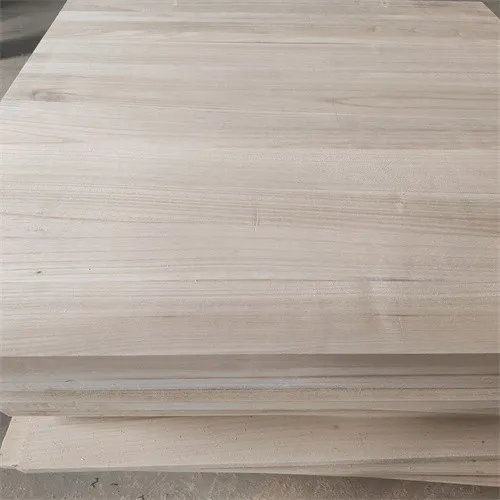
If you are interested in exploring the use of paulownia wood boards for your marine projects, we are here to help. Our team of experts can provide you with detailed information about our products and offer advice on how to best use them in your specific applications. Contact us to start a discussion about your procurement needs and let's work together to find the best solutions for your marine projects.
References
- "Wood Handbook: Wood as an Engineering Material" by Forest Products Laboratory
- "Boatbuilding Basics" by various authors in the boatbuilding industry