

What is the chemical composition of pine wood board?
Oct 16, 2025
Leave a message
As a supplier of pine wood boards, I often get asked about the chemical composition of these versatile materials. Pine wood boards are popular in various industries, from construction to furniture making, due to their strength, durability, and aesthetic appeal. Understanding the chemical makeup of pine wood can provide valuable insights into its properties and applications.
Basic Chemical Components of Pine Wood
Pine wood, like all types of wood, is primarily composed of three main chemical components: cellulose, hemicellulose, and lignin. These components give wood its structure, strength, and other characteristic properties.
Cellulose is the most abundant polymer in pine wood, making up about 40 - 50% of its dry weight. It is a long - chain polysaccharide made up of glucose units linked together by beta - 1,4 - glycosidic bonds. The linear structure of cellulose allows it to form strong microfibrils, which are the building blocks of the wood cell walls. These microfibrils provide the wood with its tensile strength, enabling it to withstand pulling forces without breaking easily.
Hemicellulose accounts for approximately 20 - 30% of the dry weight of pine wood. Unlike cellulose, hemicellulose is a shorter - chain and more branched polysaccharide. It consists of a variety of sugar monomers, such as xylose, mannose, galactose, and arabinose. Hemicellulose acts as a matrix that binds the cellulose microfibrils together, contributing to the overall integrity of the wood cell walls. It also plays a role in the water - holding capacity of the wood, as its hydrophilic nature allows it to absorb and retain moisture.
Lignin makes up about 20 - 30% of the dry weight of pine wood. It is a complex, three - dimensional polymer composed of phenylpropane units. Lignin fills the spaces between the cellulose and hemicellulose in the wood cell walls, providing rigidity and resistance to compression. It also acts as a natural preservative, protecting the wood from microbial attack and decay. The presence of lignin gives pine wood its characteristic brownish color and contributes to its hardness and density.
Minor Chemical Components
In addition to the major components, pine wood also contains a variety of minor chemical components, including extractives, ash, and water.
Extractives are a diverse group of compounds that can be extracted from wood using solvents such as water, alcohol, or ether. They make up about 2 - 10% of the dry weight of pine wood and include substances such as resins, tannins, terpenes, and flavonoids. Resins are sticky substances that are produced by pine trees as a defense mechanism against insects and pathogens. They can also enhance the durability and weather - resistance of the wood. Tannins are polyphenolic compounds that can give wood a characteristic color and flavor. They also have antibacterial and antifungal properties. Terpenes are volatile organic compounds that give pine wood its characteristic aroma.
Ash is the inorganic residue that remains after wood is burned. It typically makes up less than 1% of the dry weight of pine wood and consists of minerals such as calcium, potassium, magnesium, and phosphorus. These minerals are essential for the growth and development of pine trees and can also affect the properties of the wood, such as its hardness and strength.
Water is an important component of wood, as it affects its physical and mechanical properties. The moisture content of pine wood can vary depending on the environmental conditions in which it is stored and used. Freshly cut pine wood can have a moisture content of up to 100%, while air - dried wood typically has a moisture content of around 12 - 20%. Kiln - dried wood can have a moisture content as low as 6 - 8%. Controlling the moisture content of pine wood is crucial to prevent issues such as warping, cracking, and decay.
Impact of Chemical Composition on Pine Wood Board Properties
The chemical composition of pine wood has a significant impact on the properties of pine wood boards. For example, the high cellulose content gives pine wood boards their strength and stiffness, making them suitable for structural applications such as framing and decking. The presence of lignin and extractives contributes to the durability and resistance to decay of pine wood boards, making them a good choice for outdoor applications.
The moisture content of pine wood boards also affects their properties. Wood with a high moisture content is more prone to warping and shrinking as it dries, which can lead to problems such as uneven surfaces and loose joints. Therefore, it is important to ensure that pine wood boards are properly dried before use.

Different Types of Pine Wood Boards and Their Applications
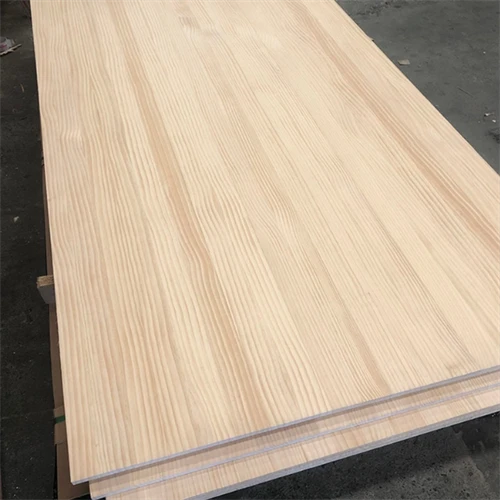
At our company, we offer a variety of pine wood boards to meet the diverse needs of our customers. One of our popular products is the Edge Glued Pine Board. These boards are made by gluing together narrow strips of pine wood along their edges to create a wider board. Edge glued pine boards are known for their stability and uniform appearance, making them ideal for furniture making, cabinetry, and interior paneling.
Another product we offer is the Finger Jointed Pine Boards. Finger jointed pine boards are made by joining shorter pieces of pine wood together using a finger - jointed connection. This type of connection provides a strong and durable bond, allowing for longer and more stable boards. Finger jointed pine boards are commonly used in construction, such as for wall studs and rafters, as well as in the manufacture of doors and windows.
We also supply Pine Edge Glued Board, which is similar to edge glued pine board but may have different specifications and characteristics depending on the specific requirements of the customer. These boards are suitable for a wide range of applications, from flooring to decorative elements.
Conclusion
In conclusion, the chemical composition of pine wood plays a crucial role in determining its properties and applications. The combination of cellulose, hemicellulose, lignin, and other minor components gives pine wood its strength, durability, and unique characteristics. At our company, we understand the importance of providing high - quality pine wood boards that meet the specific needs of our customers. Whether you are a contractor, a furniture maker, or a DIY enthusiast, we have the right pine wood board for your project.
If you are interested in purchasing our pine wood boards or have any questions about their chemical composition, properties, or applications, please feel free to contact us. We are more than happy to assist you in finding the perfect solution for your needs. Let's start a conversation about your project and explore how our pine wood boards can add value to it.
References
- Fengel, D., & Wegener, G. (1984). Wood: Chemistry, Ultrastructure, Reactions. Walter de Gruyter.
- Rowell, R. M. (Ed.). (2005). Handbook of Wood Chemistry and Wood Composites. CRC Press.
- Siau, J. F. (1984). Transport Processes in Wood. Springer - Verlag.